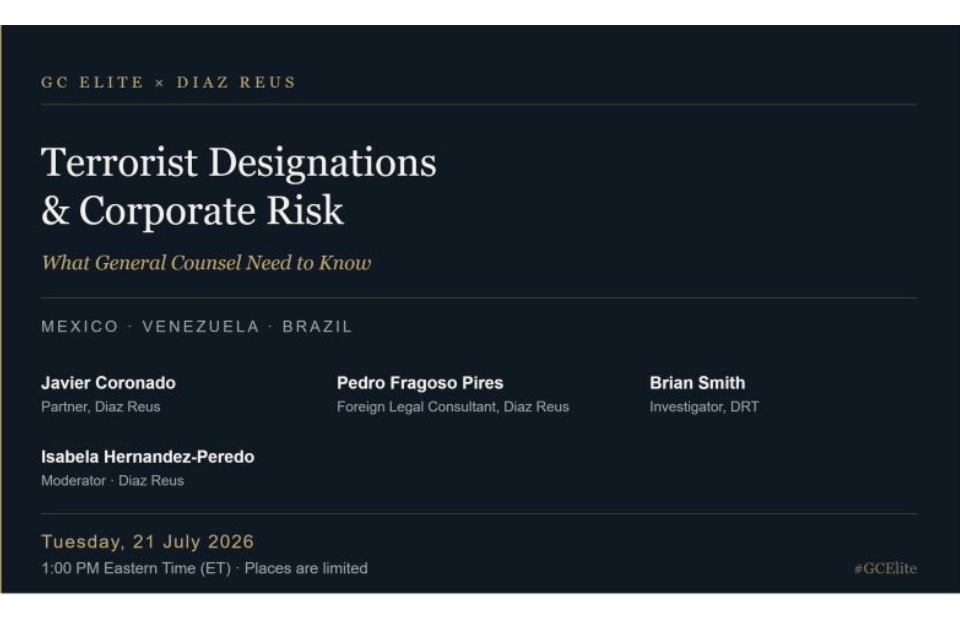
Summary of the webinar organized by GC Elite (July 21, 2026) with Diaz Reus attorneys Javier Coronado Diaz, Pedro Fragoso Pires, Isabela Hernandez-Peredo and DRT Investigator Brian Smith.
Before our panel spoke a single word on July 21, the audience had already told us something important.
Of the General Counsel, compliance leaders, and senior legal professionals who registered from across Latin America, the US, Europe, Africa and the Middle East, 75% reported having significant or limited operations in Latin America. Yet more than half (56%) described themselves as limited, not prepared, or simply unsure of their readiness to identify and mitigate FTO-related exposure. And when asked what their most pressing unanswered question was, 53% gave the same answer: we need to understand our OFAC and SDGT obligations in practice, not just in theory.
That is exactly what the webinar set out to address.
What Changed, and Why It Matters Now
Brian Smith, former DEA Special Agent and now with DRT Investigations, opened by framing the shift. FTO designations were historically reserved for ideologically driven terrorist organisations. What changed is the scope: the US government has now extended the framework to transnational criminal organisations whose defining characteristic is violence and criminal activity, including drug trafficking cartels operating in Latin America. The consequence is that OFAC and the full enforcement apparatus of the US government can now target these organisations, and anyone connected to them.
The material support doctrine is the critical concept for businesses. It is broad, it is interpreted expansively, and it extends to conduct occurring entirely outside the United States. Critically, it does not require intent. The concept of willful blindness, knowing a risk exists and choosing not to act on it, is sufficient to attract liability. As Javier Coronado, Partner at Diaz Reus, put it plainly: if your organisation has heard rumours about extortion payments being made and has not taken action, that may be enough to trigger an investigation.
Beyond Extortion Payments
The Chiquita Brands case is the case most GCs associate with material support liability, a company making protection payments to a designated organisation. Javier Coronado’s message was that the framework has has reaffirmed this consequence while expanding its scope to address additional legal risks.
Prosecutors and investigators in the US are now pursuing material assistance cases connected to logistics, companies providing operational support to cartel activity without ever making a direct payment. Following the use of anti-fentanyl authorities against three of Mexico’s largest financial institutions (resulting in their effective liquidation), the message to businesses is clear: FTO designations have consequences that cascade across the entire commercial ecosystem.